
An AI writing tool can produce a draft quickly. The harder job is making sure the article answers a real question, cites reliable information, and gives readers something they can use. If editing takes longer than writing the original, faster generation has not improved the publishing process.
This guide introduces Writesonic and proposes a small editorial pilot for evaluating it. Official product information was checked on October 10, 2026. The worksheets and examples are our own planning suggestions, not product test results or client case studies. We have not completed a hands-on comparison of the workflow described here.
Link disclosure: Our Writesonic affiliate application was pending at the last confirmed check on October 9, 2026. The service button currently links to the normal official website, not an affiliate URL. A future affiliate link would require confirmed approval and updated disclosure.
What is Writesonic?
Writesonic offers tools around content creation and visibility in AI search. Its official AI Article Writer page describes an article pipeline with research, drafting, review, citations, and publishing features. It also advertises brand voice controls and CMS export options.
Treat those descriptions as vendor claims to verify against your requirements and current plan. They do not establish that every generated citation is accurate, that your article will rank, or that your brand will appear in an AI answer. Publication quality still needs an accountable human reviewer.
Assign a reviewer before the one-article trial
Use a single source-backed article brief and give the editor and the test tool the same source notes. After drafting, have one reviewer mark unsupported product claims, missing qualifications, and links that fail. Record the time spent on those corrections alongside drafting time. Count a draft as ready only when the reviewer can trace important claims to the stated sources. Decide whether the tool helps this task before adding a second workflow to the trial.
Identify the part of writing that is slowing you down
Write the current process on a sheet: topic choice, source collection, outline, draft, factual review, editing, publishing, and maintenance. For the next article, record how long each stage takes and which stage requires rework.
For example, if the main delay is finding trustworthy product conditions, a faster draft may not solve it. If the delay is turning a clear brief into a readable outline, generation may be easier to evaluate. A useful pilot targets one bottleneck instead of asking the software to run the entire publication.
Choose an article with a narrow question and manageable claims. “How to prepare a downloadable checklist for sale” is easier to review than “The best way to build a profitable business.” Avoid beginning with medical, legal, or other high-stakes advice that requires specialist review.
Compare three ways to do the job
| Option | Where it may fit | Evaluation question |
|---|---|---|
| Manual writing with an editor | Small volume, specialist knowledge, or a distinctive voice | Can a better brief remove the current delay? |
| General AI assistant plus your own source sheet | Occasional drafts with an established review process | How much manual coordination and checking is required? |
| Content platform such as Writesonic | Repeated publishing with research and editing steps | Does the integrated workflow reduce total work without weakening review? |
This is a planning comparison, not a performance leaderboard. Use the same article brief and acceptance criteria when comparing options. A polished sample from one tool and a rushed draft from another would not be a fair test.
Prepare a source brief before generating content
The brief should identify the intended reader, their question, the decision the article supports, the scope, and the evidence. Add sources before asking for factual product claims. Keep confidential client material out of a tool until permission and handling requirements are clear.
Here is an original example you can adapt:
Reader: a solo creator preparing a downloadable resource. Question: what must be ready before offering it for sale? Scope: product description, sample, delivery, and a review checklist. Exclude revenue promises and claims of personal tool testing. Use only the supplied official sources for product facts. Flag missing facts rather than completing them from guesses. Label hypothetical examples clearly. End with one practical next step.
Keep an evidence sheet with four columns: claim, source URL, date checked, and reviewer decision. A pricing claim, for instance, needs a source that supports the plan and billing conditions, not a general homepage. Keep source material separate from the instructions you give the tool.
Review the outline before the draft
An outline is cheaper to repair than a finished article. Check that it answers the reader’s question in a sensible order: problem, available approaches, tradeoffs, practical steps, and decision criteria.
Remove sections that repeat the introduction or simply restate product features. Add a concrete example where the reader needs to apply a concept. If the outline names features absent from your evidence sheet, resolve them before generating the article. More headings do not automatically mean more useful depth.
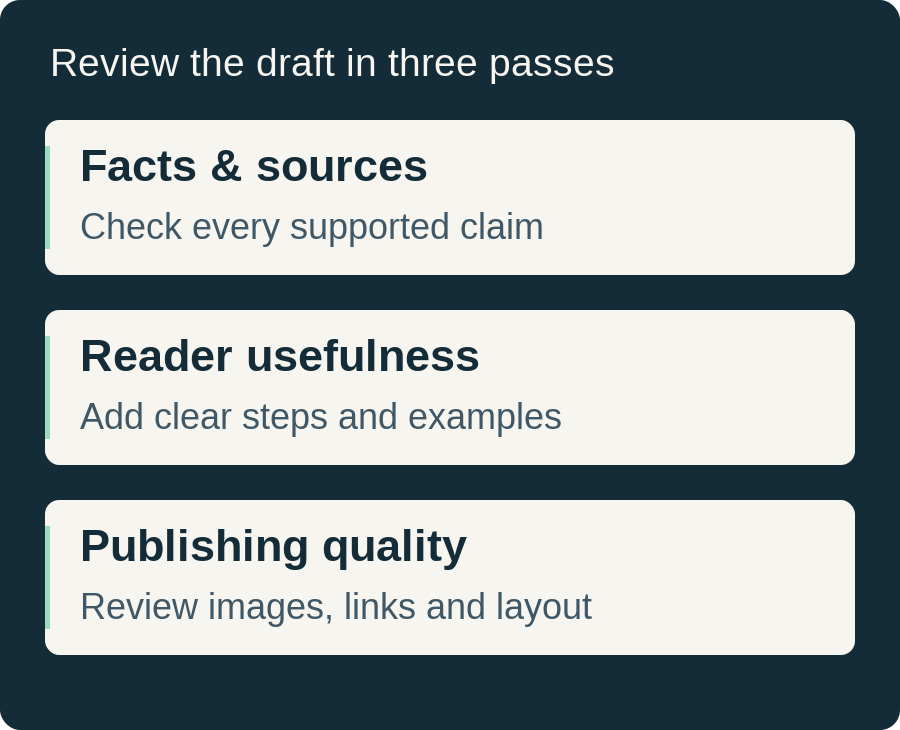
Use three review passes
Pass 1: Facts and sources
Open each cited source and check the exact claim. Look for changed prices, outdated feature names, unsupported numbers, and citations that discuss a related topic without supporting the sentence. Confirm that no fictional customer, experience, or performance result has appeared.
Automated checks may assist this work, but their presence does not remove responsibility for the published statement. Record unresolved claims as unresolved and remove or qualify them before publication.
Pass 2: Reader usefulness
Ask someone to explain the next step after reading the article. Can they use the checklist without buying a product? Are the limitations visible? Does the comparison explain who should choose a different approach?
For example, replace “AI improves your content strategy” with a useful instruction: “Choose one outdated article, list its unsupported claims, and check each one against a current official source before rewriting.” This is an editorial example, not a measured Writesonic outcome.
Pass 3: Publishing quality
Check the title, description, cover image, headings, internal links, external links, and phone layout. Confirm that any exported content retains the intended formatting and disclosure. If a feature requires connecting your CMS, review the access it requests and use a controlled test environment before production.
Measure cost per accepted article
The subscription price is only part of the cost. Add the time spent preparing sources, writing the brief, reviewing facts, revising, and fixing publishing errors. Do not assign an invented hourly rate and present it as an actual business expense.
| Measure | What to record in the pilot |
|---|---|
| Preparation time | Source collection and briefing |
| Draft time | Generation and any manual writing |
| Review time | Fact checks, edits, and rework |
| Direct tool cost | Actual subscription and usage allocation |
| Accepted output | Articles that pass the same review standard |
| Critical errors | Unsupported claims, wrong links, or invented experiences |
Compare the completed pilot with your existing process. A lower draft time alongside a much higher review time is a mixed result. If no article passes review, cost per accepted article cannot yet be calculated meaningfully.
Check the plan before paying
Consult Writesonic’s live pricing page and the terms shown during signup. Confirm the features included, usage allowance, billing period, renewal, cancellation, and any trial conditions. Do not assume a headline applies to every plan or that an article-writing subscription includes every AI visibility feature.
Also check the practical requirements: supported export format, collaborators, language needs, and data handling. If the information needed for your workflow is unclear, resolve it before connecting client accounts or committing to a subscription.
Use an acceptance decision, not a word-count target
Suppose a fictional draft invents a monthly price, repeats its introduction in the conclusion and never shows the promised example. Record three separate repairs: verify or remove the price, remove the repeated explanation, and add a completed example that answers the reader’s question.
Measure all the work. A hypothetical five-minute generation, fifteen-minute factual review and twenty-minute revision totals forty minutes. Without a measured baseline for completing the same job, that does not establish a time saving.
Keep the accepted draft, the input brief and the repair list together. A rejected draft can still explain which input or review stage needs attention. This scenario is a proposed evaluation method, not a Writesonic output or a measured benchmark.
A sensible first decision
Writesonic is worth evaluating when a repeatable content workflow could reduce coordination and your team can still review the result. If you publish occasionally or lack reliable source material, improving the brief may be the more valuable first step.
Use the official service button below to inspect the current offer. Start with one controlled article and retain the original brief, evidence sheet, and reviewed version. Decide whether to continue from the accepted output and total effort, rather than the speed of the first draft. For the preparation stage, see seven things to define before using an AI writing tool.
Record editorial cost on the same article
Give the manual and assisted workflows the same source brief. Track time spent drafting, checking sources, and repairing unsupported claims separately. If the assisted draft is faster to write but slower to verify, narrow the next trial to outlining or reorganizing verified material.