
You have a useful PDF, template, or short course. The next question is how a reader will discover it, understand the offer, pay, and receive what you promised. Buying several tools before drawing that journey can leave you with disconnected forms and unfinished pages.
This guide introduces systeme.io and a small planning exercise for a first digital product funnel. It is based on official product information checked on October 10, 2026, and our own proposed workflow. It is not a hands-on product benchmark. The example below is fictional and illustrates planning; it is not a customer result.
Affiliate disclosure: The systeme.io service button on this page uses our affiliate link. We may earn a commission from an eligible referral. Choose a tool because it fits your workflow, and check the current price and terms before purchasing.
What is systeme.io?
The official features page presents systeme.io as an integrated platform for sales funnels, email marketing, websites, online courses, and automation. A funnel is a connected sequence of pages and actions that helps someone move from interest to a specific next step.
For a small creator business, the attraction is keeping several parts of that journey together. The practical question is whether its pages, delivery options, and email workflow match your actual offer. A long feature list does not answer that question by itself.
Make the delivery step visible before launch
Outline one route for a downloadable spreadsheet: offer page, checkout, thank-you page, receipt, and working download. On the thank-you page, tell buyers where the file will arrive and how to ask for help if they cannot find it. Complete an end-to-end check using the platform’s approved test setup. If you want to compare plan limits, review the free-to-paid decision checklist separately from this delivery check.
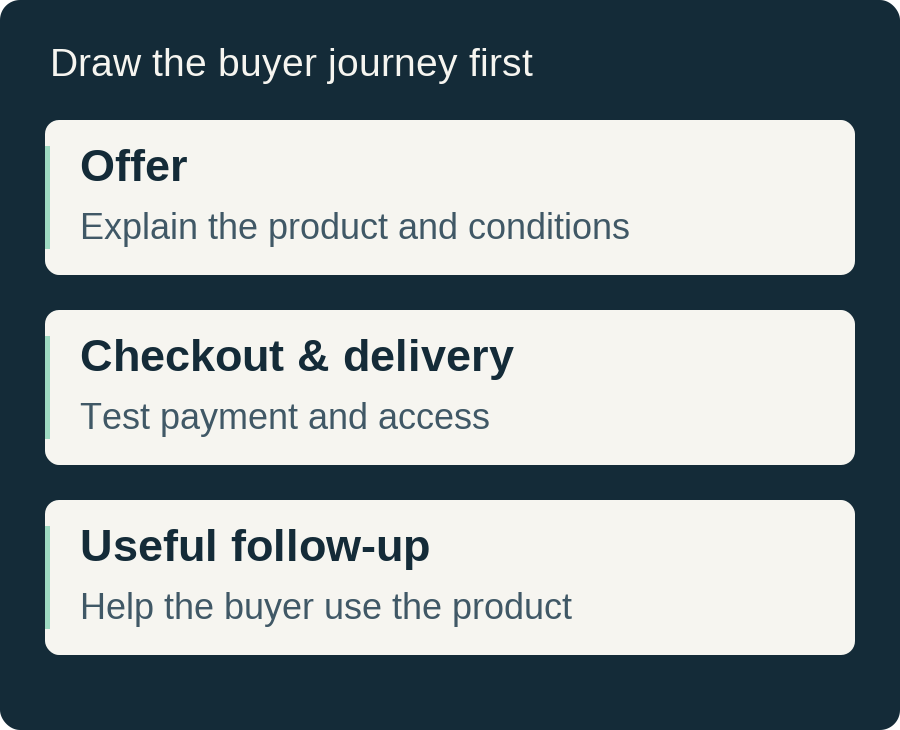
Draw the buyer journey first
Start with this sentence: “A beginner discovers my checklist, understands what it helps them do, buys it, and receives the file with clear instructions.” Replace every vague word with a specific promise.
Our planning example is a downloadable website launch checklist. It helps someone organize text, images, links, and a final review before publishing a small website. It does not include website construction, individual consulting, or guaranteed traffic. Those exclusions belong on the offer page because buyers should know the scope before checkout.
The simplest journey is:
- An educational article explains a website launch problem.
- A product page shows the checklist contents and a sample.
- A checkout states the price and purchase conditions.
- A confirmation step explains how to access the file.
- A short follow-up helps the buyer use it and find support.
Keep this map next to you while choosing software. Each step needs an owner and a way to check that it works. Do not add webinars, upsells, or a complicated email sequence until the basic journey is reliable.
Compare the implementation options
| Approach | A sensible use case | What to inspect |
|---|---|---|
| Marketplace listing | You want an established place to sell a finished file | Fees, delivery rules, buyer access, and promotion limits |
| Existing website plus separate tools | Your site and email system already work well | Integration effort, extra subscriptions, and failure handling |
| Connected platform such as systeme.io | You need to assemble pages and follow-up together | Design flexibility, plan limits, payment support, and export options |
These are general implementation choices, not a measured ranking of products. Keep your existing system if it already delivers the promised experience. Switching tools creates work: migrating pages, updating links, checking customer access, and documenting the new process.
Write an offer that a buyer can evaluate
Use five short sections: who the resource is for, the problem it addresses, what is included, what is excluded, and what happens after purchase. Show a representative sample rather than relying on adjectives such as “complete” or “professional.”
For our example, “A checklist covering page copy, images, links, and a pre-launch review” is more useful than “Everything you need for a successful website.” The second statement implies an outcome the file cannot establish.
A useful page outline is:
Prepare your website content before launch. This downloadable checklist helps first-time site owners check missing copy, image rights, broken links, and basic mobile readability. It includes a blank review sheet and a completed example. It does not include coding or an individual site review.
This is an original writing example, not approved advertising copy from systeme.io. Adapt it to the actual product you have finished. Confirm the deliverable before writing the sales promise.
Check the free plan against the whole journey
Use the current pricing page to make a requirement sheet. Record the date, contact allowance, funnel allowance, automation limits, domain options, and any restrictions affecting your offer. Avoid selecting a plan only because the headline says “free.”
| Requirement | Your answer before launch |
|---|---|
| Pages needed | Offer, checkout, and confirmation; specify any additional page |
| Buyer access | File location, access instructions, and recovery procedure |
| Payment | Supported provider, currency, fees, and refund process |
| Permission, sender configuration, unsubscribe, and delivery testing | |
| Growth limit | The actual limit that would require an upgrade |
| Exit plan | What you can export and what would need rebuilding |
Payment availability and obligations depend on your setup and location. Confirm them in the provider’s documentation. Do not collect real payments just to see whether an unfinished journey works; use supported test facilities where available.
Follow-up should help someone use the purchase
Your first message should explain access and the next practical action. For the checklist example, that could be: “Open the review sheet, choose one page, and mark the missing content before editing the design.” Include a way to report an access problem.
A later educational message can explain one common mistake, such as checking a page only on a desktop. Keep transaction information and optional marketing distinct. State what a subscriber is signing up for and make leaving the marketing list straightforward. Do not import contacts whose permission you cannot establish.
Test the journey as a new visitor
Create a test record with an address you control. Open the entry page on a phone and desktop, then follow the expected path. The following is a proposed acceptance checklist, not a report of a systeme.io test we completed:
- The page states the audience, contents, exclusions, and purchase conditions.
- The primary button has a clear label and reaches the intended step.
- Form errors are understandable, and unnecessary information is not requested.
- Supported payment tests show the intended amount and currency.
- The confirmation page and email describe the same access method.
- The file opens, uses readable text, and matches the product description.
- A buyer can recover access and find the support or refund procedure.
- Optional marketing has a clear permission and unsubscribe process.
Record the result for each item. An unchecked item is unknown, not a pass. If a buyer cannot receive the product, stop the launch and repair delivery before promoting it.
Decide what to measure
Track product-page visits, checkout starts if available, completed orders, refunds, access problems, and support time. Record the reporting period and source. An unmeasured event is not zero. Small traffic counts also need context: five visits and no orders cannot establish that the product or platform is unsuitable.
Choose the next change from the observed bottleneck. If readers reach the page but cannot understand the file, improve the sample and description. If buyers cannot access it, fix delivery. If qualified visitors are absent, work on distribution before rebuilding the checkout.
When is systeme.io worth considering?
It is worth evaluating when a creator needs a connected page and email workflow and can keep the first offer simple. A specialized store, complex fulfillment process, or already reliable tool stack may call for a different approach.
Use the service button below to inspect systeme.io, then compare the live plan details with your requirement sheet. Your goal is one clear offer with reliable delivery. Once that works, use the five elements of a sales funnel to plan the next improvement.
Make a delivery test record before building more pages
For a fictional single-PDF offer, prepare three checks: does the mobile page show the contents and exclusions; does the purchase step show the intended product, currency and billing unit; and does the available preview or test route open the correct file?
Record the test method beside each result. A preview of the offer does not prove a completed payment or buyer download. If a step cannot be checked, leave it unverified and ask the provider how to test it. Do not perform repeated live payments merely to discover whether the setup works.
Once the file opens, read its first instruction as a new buyer. A successful download is only part of delivery; the reader also needs to know where to begin and where to ask for help within the stated support scope.
Keep purchase and delivery states visible
For a PDF, write what the buyer sees after successful payment, after a failed payment, and if the download message never arrives. Test each path your setup supports and give buyers a clear contact route when delivery cannot be confirmed.